THE WINDOWSERVE FIELD GUIDE
How to choose the right window treatments.
A beautiful room starts with the right light. Find the blinds, shades, shutters or drapery that fit the way you live.
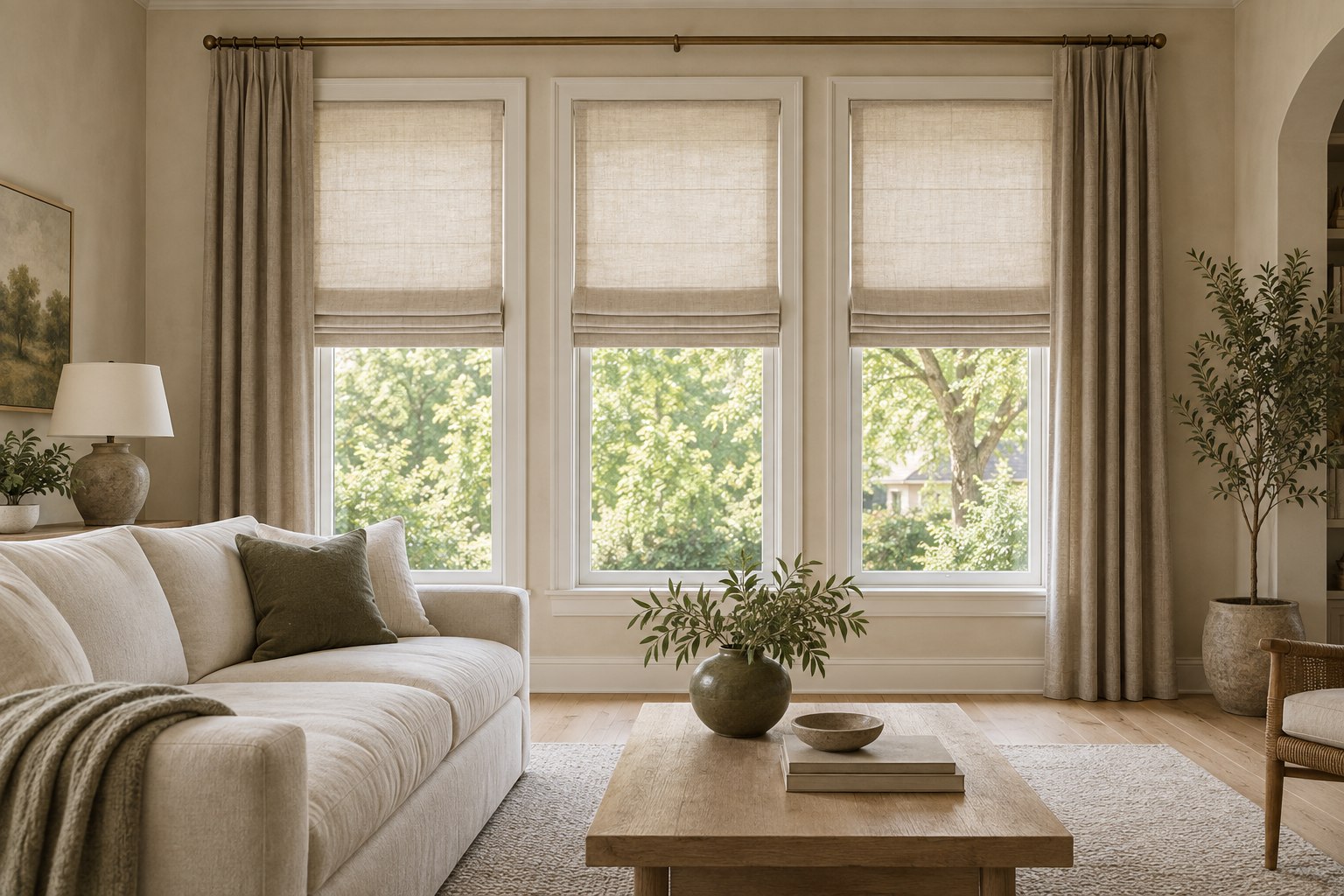
THE SHORT ANSWER
Start with the room.
Then choose the look.
The right window treatment balances light, privacy, fit and everyday use. Decide what the room needs first, check the window’s dimensions and surroundings, then choose your material, color and controls.
A bedroom and a sunny kitchen can share a palette without using the same product.
A LITTLE DIRECTION
Find your starting point.
Three choices to help you build a shortlist. Samples and a window check will help you make the final decision.
YOUR STARTING POINT
No email needed. Your selections stay in this page.
01 / THE ROOM COMES FIRST
What do you need your windows to do?
Before you fall in love with a fabric, spend a day noticing the room. Where does the sun land? When do you switch the lights on? Which windows face a street, neighbor or walkway? A good choice solves the problem you actually experience.
Set the mood
Keep the room bright, soften strong sun, reduce glare or create a darker place to rest.
Check both sides
Consider the view into the room during the day and after dark, with indoor lights on.
Make it easy
Think about opening windows, cleaning, reaching controls and moving through doors.
Try this: write down one must-have and one nice-to-have for each room. “Privacy at night, with a soft linen look” is a more useful starting brief than “something neutral.”
02 / KNOW YOUR OPTIONS
Blinds, shades, shutters or drapery?
Blinds adjust with tilting slats. Shades typically roll, fold or lift a fabric panel. Shutters place adjustable louvers in framed panels. Drapery hangs from a rod or track and can frame the window or close across it. Each family includes different materials and levels of light control.
Compare the tradeoffs below. On a small screen, scroll the table sideways.
| Treatment | A good starting point for | What to check |
|---|---|---|
| Wood & faux wood blinds | Adjustable daylight and a structured, familiar look. | Slat clearance, cleaning and the weight of a wide blind. Closed slats can still admit light. |
| Roller shades | Clean lines and a broad choice of light-filtering, opaque or solar fabrics. | Fabric privacy, edge gaps and how the roller or cassette looks when raised. |
| Cellular shades | A compact fabric treatment with insulating air pockets. | Opacity, cell size, cleaning instructions and product-specific energy ratings. |
| Roman shades | The softness of fabric in a tailored, folding shade. | Lining, pattern placement and how much of the glass the raised fabric stack covers. |
| Solar shades | Managing strong sun and glare while retaining some view. | Fabric openness and nighttime privacy; a separate privacy layer may be needed. |
| Plantation shutters | An architectural finish with adjustable louvers. | Panel swing, frame depth, obstructions and materials suited to the room. |
| Drapery & curtains | Texture, softness and a second layer over a blind or shade. | Lining, fabric care, panel fullness, rod support and space for open panels. |
03 / GET THE LIGHT RIGHT
Light filtering is different from blackout.
Color alone will not tell you how a treatment performs. A pale fabric can have an opaque backing; a dark open weave can still let you see through it. Compare the exact fabric and lining, held up at your window.
Sheer
Softens the light and preserves an airy feel. Usually needs another layer where privacy matters.
Light filtering
Diffuses daylight. The amount of screening varies with weave, color and lighting conditions.
Room darkening
Reduces light more substantially. Ask what that label means for the specific product.
Blackout fabric
Blocks light through the fabric. The complete installation can still have perimeter gaps.
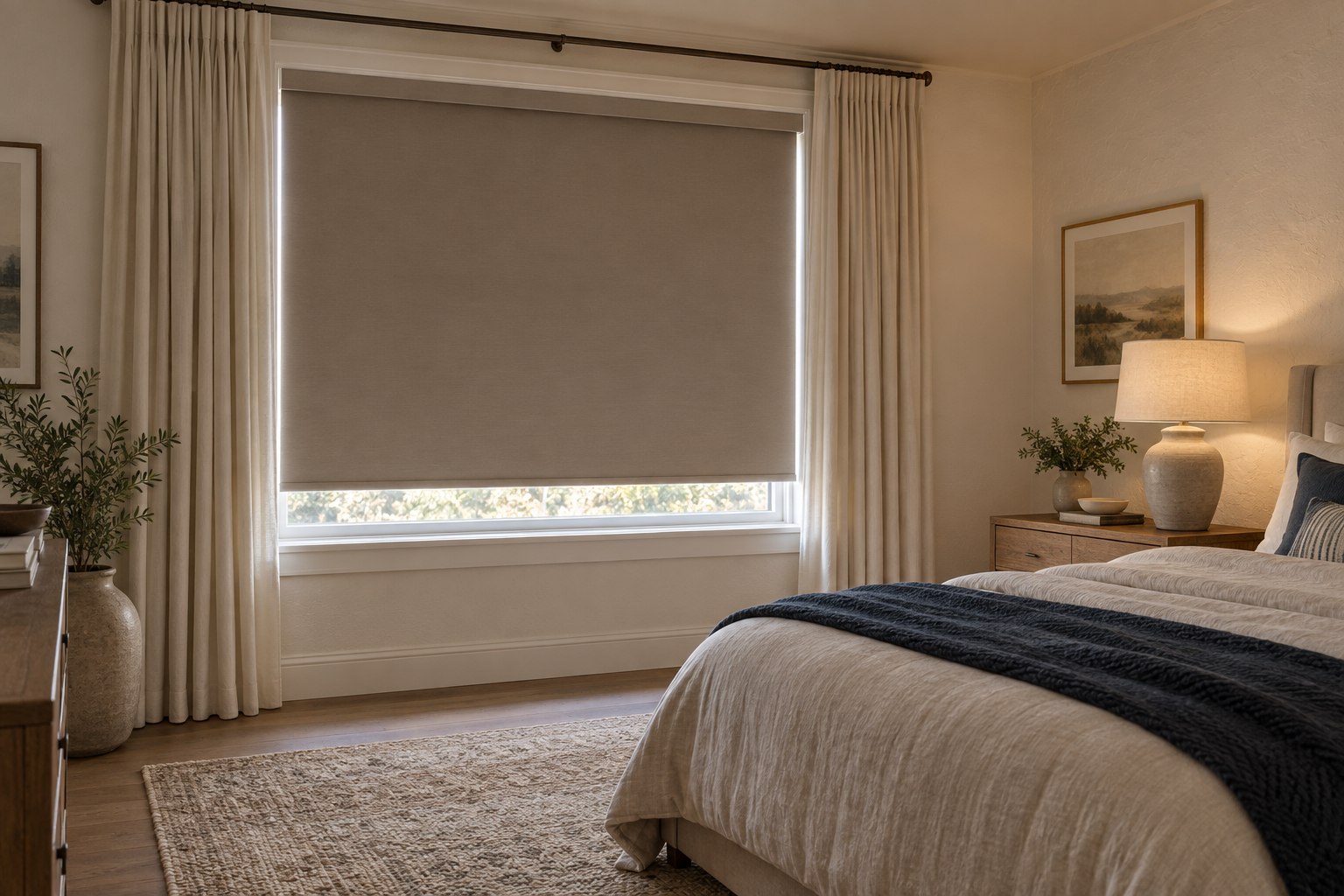
For darkness, compare the whole installation
A fabric label is only part of the answer. Mounting position, overlap and compatible side channels or drapery can help limit light around a shade. Ask to see how the proposed system deals with edge light. Manufacturer guidance on light-blocking features explains why lining and fit matter together.
For privacy, check the view after dark
Do not assume a daytime view tells you what happens at night. In particular, solar shades can reveal the interior when it is brighter inside than outside. Fabric openness describes how open the weave is; it is not a nighttime privacy rating. Compare samples and add a separate privacy layer if needed. Read more about solar shade openness and privacy.
04 / PUT IT IN CONTEXT
Choose window treatments room by room.
Living & dining rooms
Start with the balance between daylight and evening privacy. Roller or Roman shades keep the look tailored; blinds and shutters let you angle the light. Drapery can connect the windows to the rest of the furnishings.
Ask: Will the treatment look good both open and closed?
Bedrooms
Plan around sleep times, outside lighting and morning sun. Compare opaque roller or cellular shades, lined Roman shades, or layered drapery. Include the mounting arrangement in the conversation about darkness.
Ask: Where could unwanted light enter?
Kitchens
Consider the window’s distance from the sink and cooking area. A treatment you can maintain easily may matter more than a delicate texture. Follow the specific product’s cleaning and placement instructions.
Ask: How will I clean this in everyday use?
Bathrooms
Prioritize privacy and a material approved for the expected humidity or splashes. Suitable synthetic shutters or moisture-resistant blinds may be worth comparing; confirm the rating for the actual product.
Ask: Is this product suitable this close to the shower?
Home offices
Observe when sunlight reaches your screen. Solar shades can help manage glare; adjustable blinds offer another way to redirect light. Check privacy needs separately if the office faces a street or another home.
Ask: Can I work comfortably without closing off all daylight?
Patio & French doors
Think about frequent use, handles and the direction the door opens. Compare treatments designed for the opening, including options that traverse sideways. Plan a place for fabric or panels to stack clear of the route.
Ask: Will it stay out of the way when we use the door?
For humid-room product considerations, see this manufacturer’s bathroom guide. Moisture resistance and waterproof performance are different claims; check the selected product’s limits.
05 / THE FINISHING DETAILS
Choose materials you’ll enjoy living with.
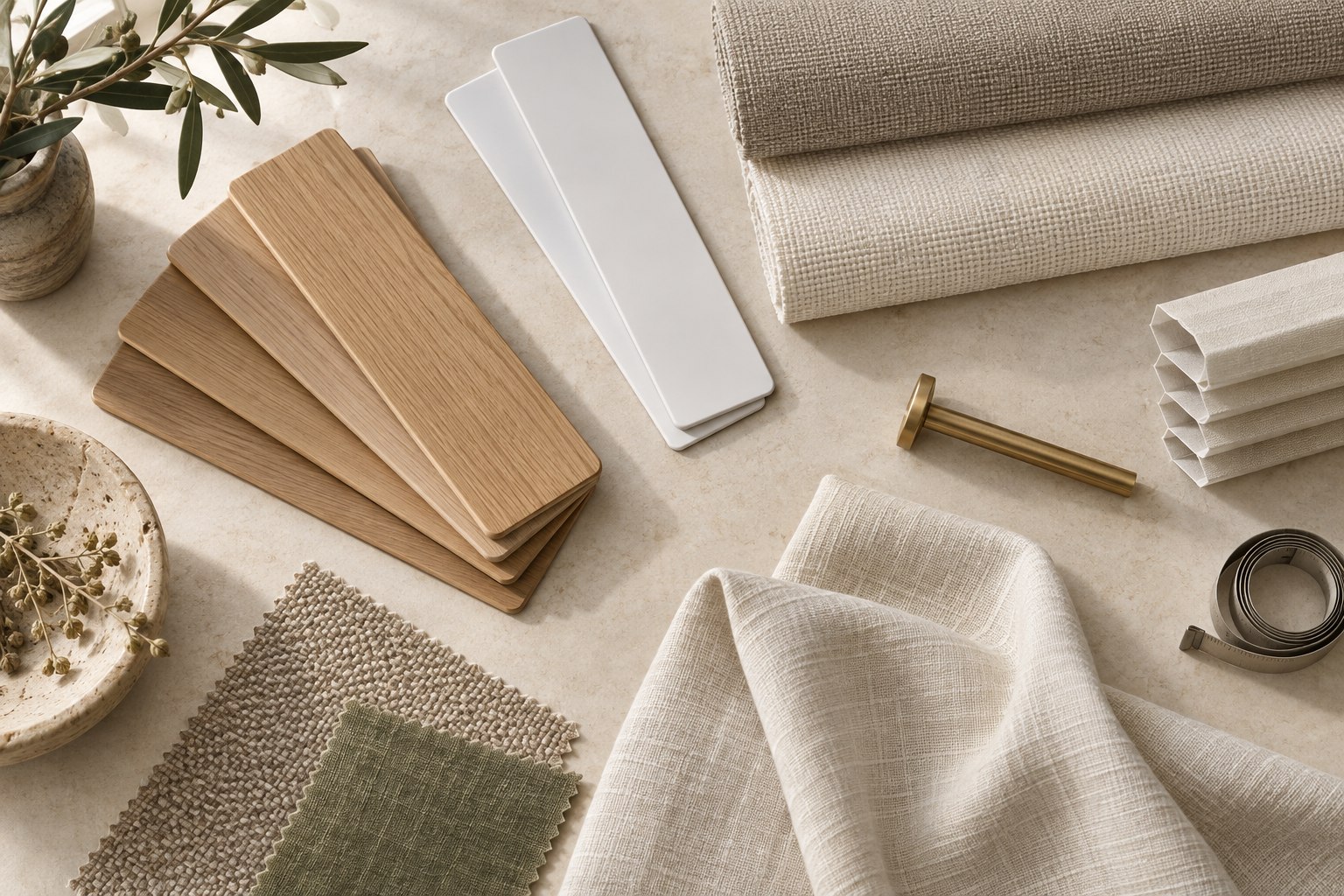
Compare texture, care and the room’s conditions
Real wood adds grain and warmth; faux wood offers a different material and maintenance profile. Fabric treatments range from smooth and minimal to textured and substantial. Look at a larger sample when possible: a tiny swatch will not show the full effect of a weave, pattern or fold.
Ask for the care instructions before you order. Some products allow gentle wiping, while others need careful dusting or specialist cleaning. A wipeable slat and a textured fabric may suit very different routines.
Use color to connect the windows to the room
Matching your trim can make a treatment feel integrated. A color close to the wall creates a quieter effect; a contrasting fabric makes the window more of a feature. Check undertones in morning and evening light, and compare any visible backing from outside.
Across an open floor plan, repeat a color, texture or hardware finish for continuity. The treatments can still differ by room. A coordinated palette leaves room for a practical kitchen blind and a softer dining-room treatment.
06 / MAKE THE FIT WORK
Inside mount or outside mount?
The same treatment can look and perform differently depending on how it is installed. Check recess depth, handles, locks, trim and the movement of the window before choosing a mount.
Inside mount
Fits within the opening and leaves the trim visible. Needs sufficient depth and room for the treatment to move. Allow for the product’s normal edge clearances.
Outside mount
Attaches above or beyond the opening and overlaps it. Useful when the recess is shallow or more coverage is needed. Plan the overlap and bracket positions carefully.
Illustrations show the general difference, not installation dimensions.
Measure to understand the opening; order to the product’s instructions
For planning, record the width and height in more than one place, the available depth, and any handles or obstructions. Measure each window separately even if they look identical. Note which way casement windows or doors open.
Do not subtract a standard amount from every measurement. Manufacturers use different ordering and deduction rules. WindowServe’s professional measurement confirms the dimensions, mounting position and operating clearance for the product you select.
07 / EVERYDAY OPERATION
Choose controls you can comfortably use.
A manually operated cordless shade can be straightforward when you can reach it. For tall windows, windows behind furniture or several shades used together, motorized blinds and shades may make daily adjustment more practical.
Ask what the motor actually moves: a blind may tilt its slats, while a roller shade raises and lowers fabric. Plan access for charging or battery replacement. App control, schedules and voice control depend on the specific system and may require extra equipment. Our motorized window treatment guide explains power and compatibility in more detail.
08 / PLAN THE PROJECT
Compare the complete quote.
Custom window treatment pricing depends on opening size, material, lining, operating system, hardware and installation needs. A large shade with a motor and an opaque fabric covers a different scope from a small manually operated blind. Compare proposals with the same specifications.
Ask whether the quote includes measurement, brackets, installation, controls and any power accessories. Check care instructions and the warranty for both the treatment and its components. If you are updating in stages, start with the rooms where privacy or light is most urgent, then plan a coordinated finish for later rooms.
SAVE THIS FOR YOUR CONSULTATION
Your window treatment checklist
- The rooms and windows you want to update.
- Your main light, privacy or access problem in each room.
- Photos of the full window, trim, handles and nearby furniture.
- Your preferred colors, textures and a few inspiration images.
- Any humidity, cleaning, child-safety or reach concerns.
- Whether you want manual, remote or smart-home controls.
- Your project budget, timing and whether you will work in phases.
- A clear list of what the quote and installation include.
A FEW MORE THINGS
Window treatment questions, answered.
What is the best window treatment for privacy?
Start with a product designed for privacy and check it in the lighting conditions that matter to you. Opaque fabrics or linings may be useful when nighttime privacy is important. Blinds and shutters need to be positioned appropriately, and sheer or solar fabrics may need an additional layer.
Are blinds or shades better for a living room?
Blinds let you change the angle of the slats without raising the entire covering. Shades offer a different range of fabric textures and opacity. If you want adjustable directional light, compare blinds or shutters; for a continuous fabric look, compare roller, Roman or cellular shades.
Will blackout shades make a room completely dark?
Blackout fabric addresses light passing through the fabric. Light may still enter around the edges of an installed shade. Discuss coverage, mounting and compatible light-blocking accessories when you need greater darkness.
Do all the window treatments in a home need to match?
No. You can repeat a color, material or hardware finish while choosing different treatments for different rooms. In connected spaces, look at the windows together and compare how the open and closed treatments will appear.
What should I choose for humid rooms?
Choose a specific product approved for the room’s humidity and any direct moisture exposure. Some synthetic shutters or alternative-wood blinds are suitable; the material category by itself is not enough. Ask about care, cleaning and placement near sinks or showers.
Can I keep my existing curtains and add a shade?
Often, yes, if there is enough space for the shade, brackets and curtain movement. Check mounting depth, handles, rod position and the finished look with both layers open and closed. Bring photos of the existing setup to your consultation.
How does a WindowServe consultation work?
WindowServe brings samples to your home so you can compare treatments in your own light. We help you choose the product and finish, professionally measure your windows, and provide a project-specific quote and installation. Request a free in-home consultation in the Des Moines metro.
FROM IDEAS TO YOUR WINDOWS
See what works in your own light.
Bring your questions. We’ll bring the samples. WindowServe helps homeowners in Des Moines, West Des Moines, Ankeny, Urbandale, Waukee and surrounding communities compare treatments, confirm the fit and plan installation.
GO A LITTLE DEEPER
Explore a treatment in detail.
Once you have a shortlist, compare the choices that matter for that product: faux wood blind materials, cellular shade construction, roller shade fabrics, shutter frames and louvers, or drapery fullness and lining.
Find a buying guide for each of our 17 product types in the WindowServe product catalog.