WindowServe buying guides
How to Choose Cellular Shades
Cellular shades deserve a closer look when you want a quieter visual style, useful privacy, and an insulating layer at the window. Their honeycomb construction is different from a single sheet of pleated fabric. The important buying decision is how the complete shade will work in your room, including its fabric, fit, controls, and the times you actually close it.
The short answer
Choose cellular shades by starting with the room's light and privacy needs, then compare cell construction, available sizes, and lift options. Light-filtering fabric can suit shared living spaces; a room-darkening fabric package may suit a bedroom. A well-fitted insulating shade can help manage heat transfer, but it will not repair a leaking window. Ask to see the proposed fabric in daylight and with indoor lights on, and verify that the controls are reachable.
Before you choose
- Cell construction and fabric opacity are separate decisions: a honeycomb shade is not automatically a blackout shade.
- Compare the performance and dimensions of the exact product instead of judging insulation from cell count alone.
- Fit, daily operation, and safe access to controls matter as much as the fabric sample.
What makes a cellular shade different?
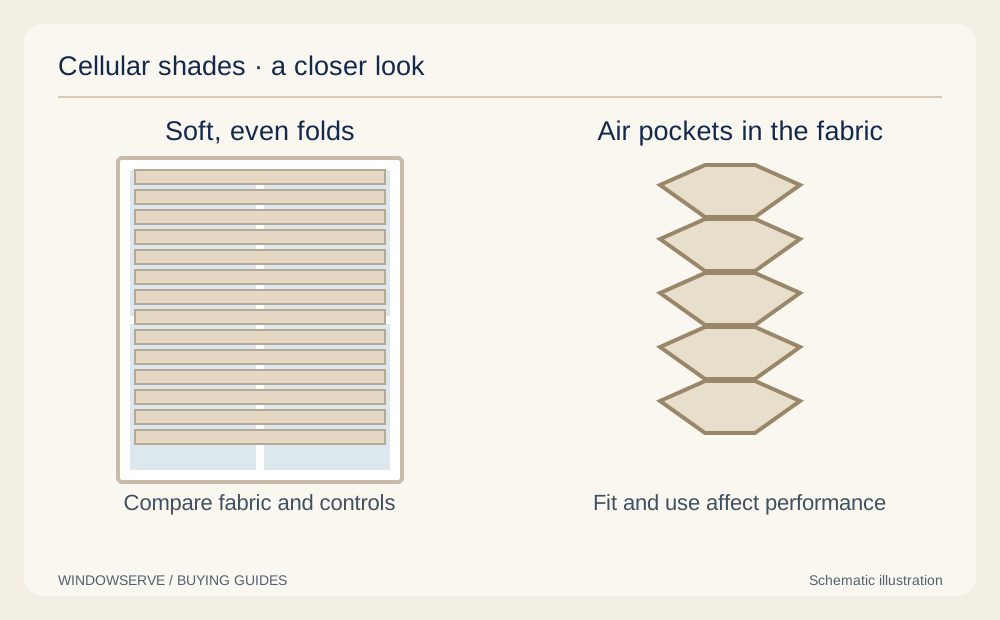
Look at the side of a cellular shade and you will see pockets resembling a honeycomb. A conventional pleated shade has a zigzag profile without the same enclosed structure. Cellular shades compress upward when opened and cover the glass with continuous fabric when lowered; they do not tilt like a slatted blind.
The Department of Energy's cellular shade research explains that the cells trap air and can improve window insulation. Actual savings depend on the product, installation, existing windows, climate, and operation. A research result is not an estimate for your utility bill.
Start with the problem you want to solve. If it is afternoon discomfort, identify the affected windows and hours. If it is nighttime privacy, inspect the proposed fabric under those conditions. If it is an obstructed view, remember that you must raise the shade to see clearly through the opening.
Single cell, double cell, and cell size
Single-cell and double-cell describe the arrangement of fabric pockets. Cell size describes the scale of the pleats. These are related design choices, but they are not interchangeable labels. A large single cell can look different from a smaller double cell even when both are offered in a similar color.
Graber's cellular collection illustrates several cell sizes and constructions. Availability varies by fabric and operating system, so the useful comparison is between two complete specifications that can actually be ordered for your windows.
| Decision | What to check |
|---|---|
| Cell construction | Insulating performance of the exact product, not just the number of cells. |
| Cell size | How the pleat scale looks across a small window versus a wide opening. |
| Fabric package | Light transmission, exterior-facing color, care instructions, and availability. |
| Finished dimensions | Headrail depth, compressed stack, and permitted width and height. |
When insulation is a priority, ask whether independent attachment ratings are available for the quoted configuration. Keep appearance in the discussion: the treatment should still look right when most of the windows are closed.
Choose light filtering or room darkening separately
Light-filtering fabric softens incoming light. It can make a living room feel bright while obscuring a direct view through the fabric, but privacy depends on the specific material and lighting. Hold a sample toward a bright source and inspect it from both sides. For a street-facing room, test nighttime silhouettes rather than assuming a daytime demonstration tells the whole story.
A room-darkening or blackout fabric package reduces light through the material more strongly. Light can still enter around the edges, headrail, or meeting point of adjacent shades. Ask what the proposed installation can realistically achieve before purchasing for a nursery, daytime sleeping, or a media room.
Color is a separate aesthetic choice. A dark-looking shade is not necessarily a blackout fabric; an opaque white fabric may block more light than a loosely constructed darker one. Compare labeled opacity samples, then choose the tone that works with your trim and furnishings. See our blackout shade guide for the distinction between fabric and whole-window darkness.
Set realistic energy and comfort expectations
For a Des Moines home, think about both summer sun and winter comfort rather than choosing one permanent shade position for every season. An insulating covering is useful only when it is positioned where it can do its job. A shade left fully raised all evening does not provide the same window coverage as one lowered.
Make a simple room schedule before considering automation: when is the room occupied, when does direct sun reach the glass, and when is outdoor light welcome? This is a practical way to decide whether you would actually adjust manual shades or benefit from scheduled operation.
Do not treat cellular shades as a repair for failed seals, water leaks, rotten frames, or drafts that need attention. If you can feel air moving around a closed sash, have the window condition evaluated. Notice persistent condensation as well, and address the moisture source rather than assuming fabric will solve it. Product performance discussions should sit alongside good window maintenance.
Would top-down/bottom-up operation help?
On a compatible top-down/bottom-up shade, you can cover the lower portion of a window while leaving an opening above. This can be useful when you want daylight in a room facing a sidewalk. It is less useful if the overlooking window is higher than your own; the uncovered area may still provide a direct sightline.
Ask for a demonstration of the exact lift system. The rail movements, reachable handles, minimum sizes, and motorized options vary. A feature shown on one sample may not be available with your preferred fabric or on a particularly narrow window.
Imagine a first-floor sitting room with a nearby walkway. A partially lowered top rail might admit sky light while covering the seated area. Check the actual sightline from the walkway and neighboring properties before calling the arrangement private.
Measure for fit, access, and a usable window
An inside mount keeps the treatment within the opening and leaves trim visible. It requires adequate mounting depth and clearance around locks, cranks, screens, and handles. An outside mount can cover more of the opening or work around shallow recesses, but it needs a suitable mounting surface and a plan for overlap.
Ask the measurer to show where the headrail and bottom rail will sit. Check whether you can still unlock, open, and clean the window, and whether a raised shade blocks a sightline you care about. Adjacent windows may need aligned headrails even when their openings are not identical.
- Identify obstructions inside the recess, including replacement-window tracks.
- Check the finished stack when the shade is fully raised.
- Discuss gaps between separate shades on a wide bank of windows.
- Confirm which measurements the manufacturer deducts before ordering.
Do not copy dimensions from an old blind without verifying how the new system is measured.
Choose controls everyone can use safely
Try a cordless sample at a height similar to your window. Consider who will use it, how much reach is needed, and whether a sofa, sink, or desk obstructs access. Motorization may help at tall or difficult-to-reach openings, but charging or power access still needs planning.
CPSC recommends cordless window coverings where children live or visit. Inspect the complete system rather than relying on a product name.
If you want an app, voice assistant, or schedules, list those requirements before ordering. A motorized option does not necessarily include the gateway or integrations you expect. Our motorized shade guide explains the questions to ask about power, connectivity, and everyday operation.
Care, wear, and rooms that need another material
Choose a fabric you can realistically maintain. Cellular material can crease or stain, so a window beside cooking splashes, an often-open dusty doorway, or a pet's favorite perch needs special consideration. A shade intended for a living space should not be assumed suitable for direct shower spray.
Consult Graber's cleaning chart before treating cellular fabric with water.
Keep the product identification and care sheet with the order. If an insect, stain, or damaged cell is inside the material, ask for a product-specific remedy before pulling at the fabric or dismantling the rails. At selection, ask how repairs are handled and whether an individual shade can be serviced without replacing matching treatments throughout a room.
Compare quotes and plan your consultation
Dimensions, fabric, cell construction, specialty shapes, lifting system, and installation conditions all affect the quote. A motorized shade also needs an itemized power and control plan. Compare like-for-like specifications rather than an isolated price per window.
Bring a short list of priorities to the appointment: the rooms that need privacy, times when sunlight is uncomfortable, windows children can reach, and any appearance requirements from outside. Ask for samples of your preferred color in more than one opacity so the decorative and practical choices are evaluated together.
For cellular shades in Des Moines, WindowServe can help compare suitable options during a free in-home consultation. The aim is a shade specification that fits your actual windows and routine, with light-control expectations documented before you order.
Common questions about cellular shades
Are cellular shades and honeycomb shades the same thing?
Usually, yes. Both names describe shades with enclosed fabric cells. A standard pleated shade has a different construction, so compare the side profile and product specification rather than relying on appearance from the front.
Are double-cell shades always the best choice?
Not automatically. Compare the exact product's performance, fabric, available dimensions, headrail, and appearance. Double-cell construction may be attractive for insulation, but a product that does not fit your window or routine is not the right solution.
Do cellular shades provide complete nighttime privacy?
Privacy depends on the fabric and installation. Test the chosen opacity with interior lights on, and inspect edge gaps and sightlines. A light-filtering sample should not be assumed equivalent to an opaque room-darkening fabric.
Can cellular shades be used on sliding doors?
Some collections offer systems designed for larger or vertical applications. Confirm availability, travel direction, stack location, and door-handle clearance; a standard horizontal shade is not automatically suitable for a frequently used patio door.
Compare options in your own home
WindowServe offers free in-home consultations in the Des Moines metro, with professional measuring and installation for your project. Bring your questions about privacy, light, materials, and fit; we can compare options at your windows.
Request a free consultationSources and product details
Manufacturer references explain particular products and options. Availability, care instructions, and warranty terms depend on the product selected.