WindowServe buying guides
How to Choose Blackout Shades
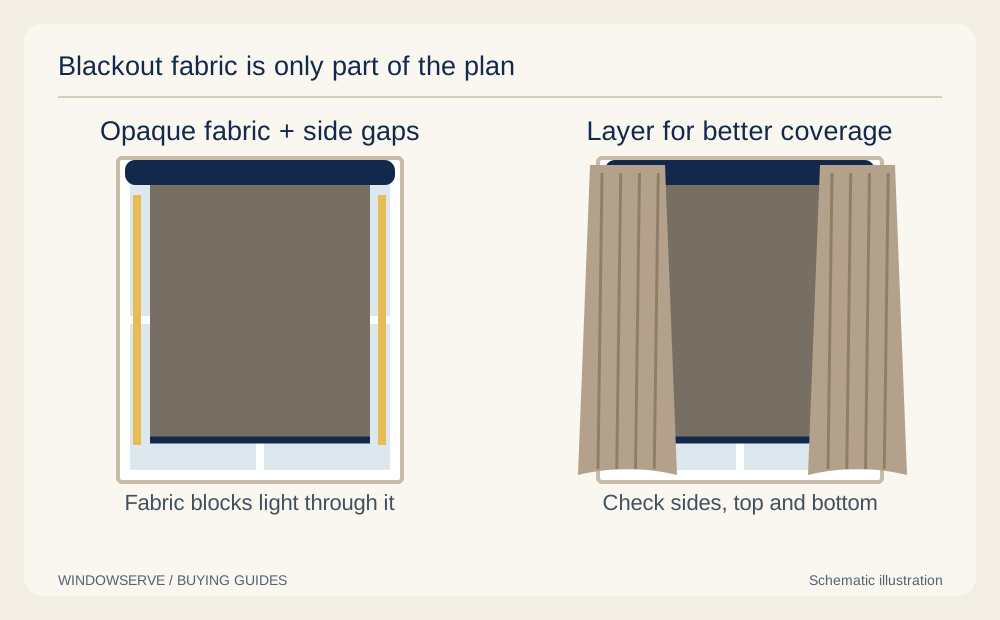
A shade labeled blackout can still leave a bright outline around the window. That does not necessarily mean the fabric is defective: light may be entering beside it rather than through it. A useful blackout plan considers the fabric, hardware, mounting, and surrounding room together, with expectations that match how you use the space.
The short answer
Choose blackout shades as a complete window system, not just a fabric label. First identify when and where unwanted light enters. Then compare an opaque fabric with the mounting, overlap, and compatible channels or layers needed to control edge gaps. Bedrooms, daytime sleeping spaces, and projection rooms may need different solutions. Ask to see how the finished system handles light at the top, sides, and bottom; no window covering can guarantee a particular sleep outcome.
Before you choose
- Blackout fabric and a completely dark room are different claims.
- Mounting and edge coverage can matter more than the visible fabric color.
- A good specification includes daytime use, privacy, safe controls, and access to the window.
Blackout, room darkening, and light filtering
Light-filtering fabrics admit diffused daylight. Room-darkening products reduce it more strongly, while blackout fabrics are intended to block light through the material. Manufacturers' labels and assembled systems differ, so ask what a claim describes: the sample fabric, the shade itself, or the complete installed treatment.
Norman's blackout roller guidance distinguishes light-blocking fabrics from options that address surrounding gaps. This is the key distinction to keep in mind when comparing quotes.
Color alone does not settle the question. A pale opaque material may transmit less light than a dark translucent one. Request the actual fabric specification and view a sample against a light source. Then ask how the proposed hardware changes the result around the sample's edges at full window size.
Avoid making the darkest possible result the default for every room. In a guest room used mainly at night, a moderate level of darkening may be sufficient. A daytime sleeping space may justify a more enclosed system.
Identify the light you actually want to block
Before selecting a treatment, inspect the room during the troublesome period. Morning sunlight, afternoon sun, a nearby security light, and a streetlight each create different conditions. A shade that looks effective during a cloudy afternoon might reveal edge leakage when direct sun reaches the opening.
- Stand or sit where the light is distracting, such as the bed or viewing chair.
- Identify whether it passes through the fabric, around the sides, above the headrail, or below the bottom rail.
- Check other openings, including a second window, transom, or glass door.
- Notice light from the hallway and electronics inside the room.
- Decide what level of darkness would be useful rather than assuming total darkness is necessary.
This audit helps you spend on the right component. Replacing opaque fabric will not solve a large side gap, and adding channels at one window will not remove light coming through a different uncovered opening.
Choose a construction that suits the room
| Approach | Why consider it? | Detail to verify |
|---|---|---|
| Opaque roller shade | A simple fabric surface and compact raised roll. | Fabric width, bracket space, and compatible gap-control options. |
| Room-darkening cellular shade | A pleated appearance with insulating construction. | Exact opacity, edge coverage, and how the rails meet the opening. |
| Lined Roman shade | Decorative fabric and folds. | Lining, raised stack, seams, and mounting overlap. |
| Shade plus closing drapery | Separate layers for appearance and light control. | Rod projection, center closure, top coverage, and side returns. |
Compare the appearance when open as well as closed. A bedroom used for reading or working during the day may benefit from a lighter secondary layer rather than switching only between bare glass and darkness. A roller shade or cellular shade can be part of different room-darkening plans; the product name alone does not specify the outcome.
Inside mount versus outside mount
An inside mount fits within the window recess and keeps the surrounding trim visible. It also needs operating clearance. A roller shade's hardware is wider than its fabric, so side light should be discussed explicitly before choosing it for a sensitive space.
An outside mount covers the opening from the wall or trim. Planned overlap can reduce direct light paths, but the distance from the fabric to the wall and the available mounting surface still matter. Do not apply a generic overlap number to every window; the product and room geometry determine the specification.
Ask the measurer to show the proposed coverage with reference to your trim and sill. Check door handles, sash locks, screens, and any obstacles. Also confirm that the treatment will not make it impractical to open a window you use for ventilation or necessary access.
When channels or another layer are worth considering
Side channels and related light-control components are designed to reduce paths around a compatible shade. Norman discusses channel systems, outside mounting, and layering as different approaches to unwanted edge light. Ask which approach is supported by the exact product being quoted.
Channels can change the visible frame around the window and the way the shade moves. Discuss their color, dimensions, bottom detail, cleaning access, and compatibility with the opening. A decorative cassette at the top is not equivalent to a complete perimeter system.
Layering may be more appropriate when you also want a soft fabric frame around the window. Closing drapery needs enough coverage and a suitable rod or track; stationary panels cannot perform the same task. Plan the layers together so the front treatment does not press against the shade or obstruct its controls.
Choose the solution based on the amount and location of unwanted light, not simply the number of products added.
Bedrooms, nurseries, and daytime sleeping
Discuss your schedule rather than describing every bedroom as identical. Someone who sleeps during daylight hours may be concerned about strong afternoon light. Another household may mainly want privacy and less illumination from a streetlight. The desired morning routine can also differ between occupants.
For a child's room, prioritize the complete control arrangement as well as light. CPSC recommends cordless coverings where children live or visit. Keep the layout and reach of furniture in the conversation.
Blackout products are a light-management tool, not a medical treatment or a guarantee of deeper sleep. It is reasonable to want a darker environment; it is not reasonable for a shade quote to promise a particular sleep result. If you also want gentle daylight during play or reading, compare a separate filtering layer or a compatible two-fabric arrangement.
Media rooms and multipurpose spaces
A television and a projector do not necessarily create the same window-treatment requirements. Identify the screen position and when the room is used. A bright reflection from one window may be the main problem, while the rest of the room can remain comfortably lit.
As a hypothetical planning example, a family room used for homework in the afternoon and films in the evening might use an opaque shade only when needed, with a lighter daytime treatment available separately. A dedicated projection room may justify more attention to the entire window perimeter.
Try to describe the result you want in practical terms: fewer reflections on the screen, less light near seating, or stronger darkness throughout the room. This gives the consultation a useful target and avoids paying for an elaborate system when a simpler adjustment meets the need.
Operation and care are part of the specification
Try the proposed lift at a realistic reach. A cordless shade may be straightforward on an accessible window; motorization may help behind furniture or across several openings. If scheduling matters, verify the exact motor, control platform, and power plan. A motor does not change the fabric's opacity or eliminate installation gaps.
Keep channels, bottom rails, and the surrounding sill free of objects that could obstruct movement. Ask for the care sheet for the complete assembly, including any backing or coating. Do not assume the opaque layer can tolerate the same cleaning method as an ordinary household fabric.
Follow Graber's care instructions for the selected material before cleaning.
For power and scheduling decisions, see our motorized shade guide.
Get a quote that states the expected result
Dimensions, fabric, channels, mounting, extra layers, and control systems all affect cost. Compare complete proposals that solve the same problem. A fabric-only price cannot tell you whether the room will achieve the darkness you want.
Ask the quote to identify the exact product and opacity, mounting approach, any gap-control accessories, included controls, and installation scope. Request an explanation of remaining light paths. A clear discussion before ordering is more useful than a vague promise that every custom product is completely lightproof.
For Des Moines metro bedrooms and living spaces, schedule a WindowServe in-home consultation. Show the windows and the hours when unwanted light matters so fabric, fit, and operation can be evaluated together.
Common questions about blackout shades
Why is light coming around my blackout shade?
Blackout fabric addresses light passing through the material. Operating gaps can remain around the sides, top, and bottom. The appropriate remedy depends on the product and mount and may involve overlap, compatible channels, or another closing layer.
Are blackout shades always black?
No. Blackout describes light-blocking performance, not necessarily the visible color. Ask to compare the selected fabric and backing against light; a pale opaque fabric can perform differently from a dark translucent one.
Can blackout shades guarantee better sleep?
No. They can reduce unwanted light, but sleep depends on many factors. Choose them for the level of darkness and privacy you want, without expecting a guaranteed health or sleep outcome.
Should every bedroom have channels?
Not necessarily. Start with the amount of darkness you want and the light paths at the actual window. Channels are one option for compatible systems; mounting or a closing second layer may be a better fit in another room.
Compare options in your own home
WindowServe offers free in-home consultations in the Des Moines metro, with professional measuring and installation for your project. Bring your questions about privacy, light, materials, and fit; we can compare options at your windows.
Request a free consultationSources and product details
Manufacturer references explain particular products and options. Availability, care instructions, and warranty terms depend on the product selected.