WindowServe buying guides
Mini Blinds: When Small Slats Make Sense
Mini blinds can be a practical choice when you want adjustable slats without a large visual presence at the window. They deserve the same attention to fit and operation as any custom treatment. A compact blind still needs enough space to tilt, controls you can reach, and a material that suits the room.
The short answer
Consider mini blinds when small slats suit the window and you want flexible daylight control with a simple appearance. Compare the material, slat size, tilt and lift functions, and mounting depth rather than choosing from the word “mini” alone. They are not automatically blackout, and narrow slats create many horizontal lines. Test a sample if you dislike that visual pattern or need very dark sleeping conditions.
Before you choose
- Confirm the material and actual slat width; mini blinds are not a single standardized product.
- Check handles and door movement as carefully as the window dimensions.
- Evaluate closed-slat privacy and cleaning access before deciding on the finish.
What does “mini blind” mean?
The term usually describes a horizontal blind with narrow slats, often made from aluminum. Retail names vary, so specify the material and slat width on your quote. Graber's aluminum collection, for example, currently includes ½-inch, 1-inch, and 2-inch options; the smaller options and the larger format should not be treated as identical. See Graber's aluminum blind options.
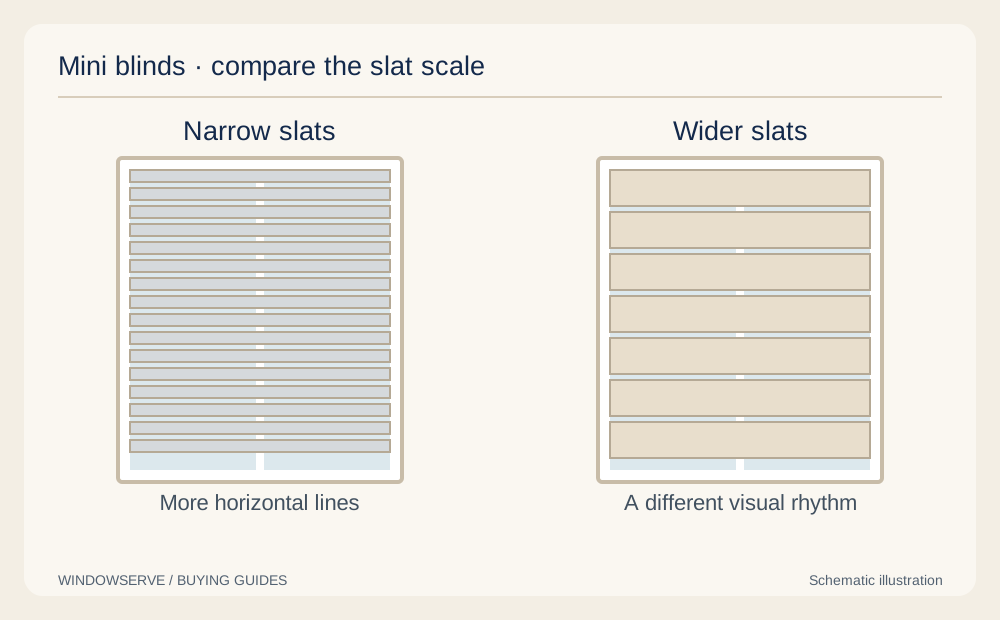
First decide whether you want the blind to be visually quiet or to contribute a strong repeated pattern. Smaller slats create more horizontal lines across the same height. That can suit a compact window, but it may look busy when several tall windows sit together. Hold a working sample in front of the opening rather than judging only from a small color chip.
Match the blind to the window and routine
Mini blinds are worth comparing for an office, utility room, small window, or glazed door where a straightforward adjustable covering is the goal. Start with how you use the opening: do you mainly tilt for privacy, raise the blind every morning, or need to open the window frequently?
| Setting | What deserves attention |
|---|---|
| Home office | Try slat angles with the screen in its actual working position. |
| Small window | Compare the headrail size and raised stack against the remaining glass. |
| Glazed door | Check handle clearance, swing path, and suitable hold-down hardware. |
| Bedroom | Assess light gaps before relying on the blind for room darkening. |
For a wide bank of windows, compare separate blinds with one continuous unit. Separate controls can be useful when you only want to open one section. Ask to see where gaps will land relative to the window frame and whether adjacent bottom rails can be aligned.
Light control is different from blackout
Tilting the slats gives you a way to adjust daylight without fully raising the blind. It also changes the outside sightline. Test the angle from the places where you sit and from the relevant outdoor viewpoint; an upstairs neighbor and a person on the sidewalk do not see the same thing.
Even with opaque slats, light can pass at the perimeter and through openings in the construction. If you want a bedroom substantially darker during the day, compare a blackout shade and its mounting details. Adding a second covering can be useful, but it should be planned around the remaining gaps rather than assumed to solve them automatically.
For an office, focus on the hours when glare interrupts work. Ask for a sample demonstration at the window and consider the desk position before selecting a darker color. A color preference and a glare-control requirement are two separate decisions.
Check depth, handles, and controls before ordering
A narrow slat does not mean the complete blind fits every shallow recess. The headrail and brackets have their own dimensions. Confirm both the minimum fixing depth and the depth needed to recess the product fully. Measure around window locks, casement cranks, screens, and any trim that projects into the opening.
For a door, open it through its full travel and check nearby walls, furniture, and the handle. Ask whether the selected blind needs approved hold-down brackets and how those brackets affect raising it. Never treat the glass size alone as the finished order size.
Test both operations: rotating the slats and raising the blind. Graber lists a wand tilt with cordless lift in its aluminum range, but available combinations depend on the selected product and size. Review the manufacturer's control options. If a counter or desk blocks the lower rail, identify that problem before ordering a manual lift.
For rooms children may use, choose cordless coverings. CPSC identifies cordless as the safest option for young children. Keep the installed product's instructions and ask for a demonstration of normal operation.
Consider cleaning and alternatives
Use Graber's care chart for your selected horizontal-blind material.
If your concern is a softer appearance, compare a fabric shade sample beside the blind. If you prefer broader slats and a painted or wood-style finish, review faux wood blinds. For natural grain, see real wood blinds. These are appearance and use comparisons; the best fit still depends on the specific window and selected configuration.
Build a quote you can compare
Price depends on dimensions, material and collection, controls, finish, and installation requirements. A low starting price does not tell you whether fitting hardware, removal of an existing blind, or difficult access is included. Compare written specifications for the same result.
- Confirm material and slat size, rather than only “mini blinds.”
- Decide whether the blind will sit within or outside the opening.
- Check lift and tilt access with furniture in place.
- Review edge coverage, headrail appearance, and any door hardware.
- Ask about care, warranty terms, and replacement-part support.
WindowServe can help compare these details during a free in-home consultation in the Des Moines metro. Start with the window's purpose, then choose a finish from the blinds collection that works with the room.
Common questions about mini blinds
Are mini blinds always aluminum?
No. Names vary between sellers and collections. Ask for the actual material, slat width, and product specification so you know what is being quoted.
Are mini blinds still available?
Yes. Graber currently lists aluminum blinds with several slat sizes and control options. Confirm the exact collection, size, and finish available for your order rather than assuming every older configuration remains offered.
Can mini blinds go on a French door?
They may be suitable if the selected system clears the handle and the door's swing path. The installer should assess the mounting surface, bracket position, and any approved hold-down hardware.
Are mini blinds a good blackout option?
Do not assume closed slats will provide blackout. Light can remain at the edges and within the construction. For a room with demanding darkness needs, compare a shade system designed around those needs.
Compare options in your own home
WindowServe offers free in-home consultations in the Des Moines metro, with professional measuring and installation for your project. Bring your questions about privacy, light, materials, and fit; we can compare options at your windows.
Request a free consultationSources and product details
Manufacturer references explain particular products and options. Availability, care instructions, and warranty terms depend on the product selected.