WindowServe buying guides
How to Choose Curtain Rods and Drapery Hardware
Drapery hardware determines more than the finish above a window. It supports the complete fabric assembly and controls how easily it opens, where it stacks, and how far it sits from the wall. Choose rods, tracks, brackets, and fabric together so the finished treatment works as one system.
The short answer
Select hardware after deciding the drapery’s heading, operating style, finished weight, and coverage. Match the rod or track to those requirements, then verify bracket spacing, mounting surfaces, and component compatibility using the manufacturer’s instructions. Leave enough room for open fabric and any second layer. A larger-looking pole is not proof of adequate support, and a decorative center bracket can interfere with movement unless the system is designed to pass it.
Before you choose
- A rod’s safe working arrangement depends on its full system and mounting, not appearance alone.
- Confirm how fabric travels past supports before ordering a wide operating treatment.
- Plan return depth and open-stack space when layering drapery over shades.
Choose between a decorative rod and a traverse track
A decorative rod can be part of the room’s visible design, with rings and finials contributing to the appearance. A traverse track carries the drapery through an operating system and may be exposed or concealed. Neither description alone tells you whether the hardware suits your chosen heading or span.
Kirsch’s hardware range distinguishes decorative collections from track and traverse options. Use that distinction to ask a practical question: how will this exact panel attach and move? A sample demonstration is more useful than choosing solely by metal color.
For a decorative stationary panel, movement may be unimportant. For drapery opened every morning, smooth travel and a comfortable control position should come first.
Match support to weight and span
Specify the weight of the finished treatment, including lining and relevant components. Then have the installer verify the rod or track, brackets, fasteners, and mounting surface as an assembly. There is no universal load limit for a curtain rod of a given diameter.
Kirsch’s resource library provides separate drapery-weight, track-performance, and installation documents. Their separation illustrates why one generic bracket-spacing rule is not enough.
Ask where supports will sit and how the open fabric’s weight is accommodated at its stacking positions. Avoid adapting a different product’s instructions or choosing wall anchors by appearance. The final mounting plan should follow the selected hardware’s documentation and the actual wall or ceiling construction.
Make sure brackets do not block the drapery
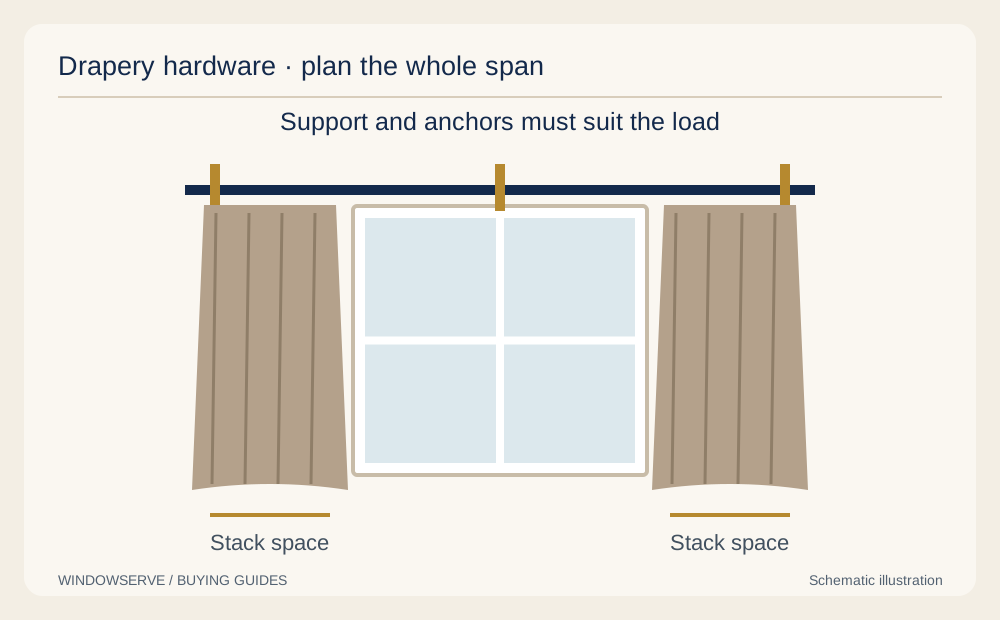
A center support may be needed for a wide span, but an ordinary ring cannot necessarily move past it. This becomes especially important when you want all the fabric to open to one side. Some systems have compatible bypass components; others use a track arrangement.
For example, Kirsch’s wrought-iron collection lists bypass rings and brackets as specific components. That does not make unrelated rings and supports interchangeable.
Describe the intended movement before the hardware is ordered: left draw, right draw, or a center-opening pair. Ask to see how the carriers or rings travel from fully closed to fully open, including every support point.
Plan rod width and open-stack space together
Measure the available wall around the window, not only the glass. Drapery takes up space when gathered open, and the amount depends on its fabric, lining, heading, and fullness. If keeping the view clear matters, ask where that open stack will sit.
Check that finials and end caps will fit near side walls, cabinets, and adjoining windows. Their decorative length may not contribute usable travel space. A compact end treatment can be worth comparing where the wall return is narrow.
Make these decisions before fabric quantities and panel dimensions are finalized. Moving a rod later can change the intended coverage, symmetry, and finished drop.
Layering needs usable depth between treatments
A double-rod arrangement can support two fabric layers, but the important question is whether both layers can move freely. Check the depth of the front and rear folds, their rings or carriers, and the clearance from any existing blind or shade.
Ask the installer to show a side view. Include window handles, projecting trim, a shade cassette, and the proposed drapery return toward the wall. More projection is not automatically better; it also changes how far the treatment extends into the room.
If the inner layer stays fixed while the outer layer opens daily, say so. Designing around the actual routine helps avoid buying a complex assembly you rarely use.
Choose the mounting position before measuring length
Wall-mounted and ceiling-mounted hardware can create different visual effects and require different attachment details. The right option depends on the construction, available space, and the chosen product. Confirm the mounting surface and fasteners before finalizing the design.
Once the position is agreed, measure finished drapery length from the correct hanging point for that heading and hardware. Include the floor’s condition and any planned flooring changes. Do not transfer a length from a previous curtain without checking the new setup.
For the fabric decisions that come first, read the custom drapery guide. For a decorative cover above the hardware, see valances and cornices.
Compare finishes after the working specification
Once suitable systems are identified, compare the finish beside your lighting, cabinet handles, and other visible metals or woods. The hardware can coordinate without matching every object exactly. Consider whether you want it to stand out or recede behind the fabric.
Graber’s hardware collection includes metal and wood options and several finial styles. Confirm current component availability for the complete arrangement rather than selecting a finial that does not belong to the required system.
Ask the quote to list rods or tracks, supports, rings or carriers, end pieces, controls, and installation. A price for the pole alone does not represent a ready-to-use drapery installation.
Check the whole system before installation
- Identify functioning drapery versus stationary panels.
- Confirm the heading, finished weight, and required coverage.
- Approve the draw direction and open-stack location.
- Verify support placement and travel past brackets.
- Check mounting depth, nearby obstacles, and any second layer.
- Finalize the hanging height before ordering panel length.
Explore WindowServe’s drapery and hardware options or request a free in-home consultation in the Des Moines area. Reviewing the fabric and hardware together helps turn a collection of attractive parts into a treatment that opens comfortably and fits the room.
Common questions about curtain rods & hardware
Can I use the same rod for heavier replacement curtains?
Only after the existing system and mounting have been checked against the replacement drapery’s finished weight and operating requirements. Matching width alone does not establish compatibility. Lining, fullness, and the open-stack position also matter.
Do wide curtain rods always need a center bracket?
Support requirements depend on the exact hardware, span, load, and mounting arrangement. Follow that product’s instructions. If a support is required, confirm how it affects the intended movement of rings or carriers.
Are double rods the best way to layer curtains?
They can work well when both layers fit and move independently. Some rooms may suit separate tracks or a shade with one drapery layer instead. Check depth, support, and access rather than choosing by the number of rods.
Compare options in your own home
WindowServe offers free in-home consultations in the Des Moines metro, with professional measuring and installation for your project. Bring your questions about privacy, light, materials, and fit; we can compare options at your windows.
Request a free consultationSources and product details
Manufacturer references explain particular products and options. Availability, care instructions, and warranty terms depend on the product selected.